Academic Library Services, East Carolina University, has recently published Congress and Countersubversion in the 20th Century: Aspects and Legacies. This book consists of essays originally posted here on the CWIS blog. It comprises a collection of 24 self-contained chapters, organized into five chronological/topical sections, covering various aspects of the efforts of the House Un-American Activities Committee (HUAC) and other 20th Century congressional committees investigating real or alleged subversion. These entries have been revised, updated, and merged as needed. There is also an introductory essay that explores the broader history of congressional countersubversive investigations. Each brief essay contains its own list of sources.
The entries span a variety of topics from the birth of congressional countersubversive investigations in the First World War and aftermath of the Bolshevik Revolution, all the way up to Russian election influence efforts in 2016-2020, and congressional investigations of white nationalism. Topics covered in-between include the origins of the House Un-American Activities Committee, the tragic injustice that was the internment of Japanese-Americans in World War Two, various aspects of McCarthyism and the Red Scare, especially the role of congressional committees such as HUAC, the 1960 Martin/Mitchell affair, the Black Panthers, and aspects of the broader Cold War espionage and political/information struggle.
This volume is intended to provide an overview and guide to further research for students, members of the public, and professional scholars.
The book is freely available through ECU’s Scholarship online repository, and is available for print purchase through UNC Press:
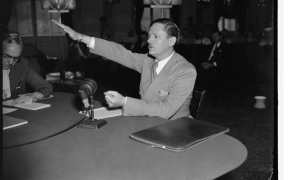
John Metcalfe, first witness to appear before the House Special Committee on Un-American Activities, discussed his experience infiltrating the German-American Bund, August 12, 1938. Source: Harris & Ewing Collection, Library of Congress Prints and Photographs Division: https://www.loc.gov/resource/hec.24931/
The following post is a revised version of an essay originally written for a compilation volume of posts from this blog. The collection, Congress and Countersubversion in the 20th Century: Aspects and Legacies, will be published in June by ECU Academic Library Services, in cooperation with UNC Press.
The hunt for subversive or “un-American” elements in U.S. history is a phenomenon generally associated with the right half of the political spectrum. When the concept of countersubversion is mentioned, it is the Red Scare, McCarthyism, and anti-communist “witch hunts” that usually come to mind. However, there have been several occasions in American history when large elements of the left have likewise embraced a countersubversive mindset regarding their adversaries. The first such occasion was in the 1930s, when much of the New Deal Left wholeheartedly embraced what has come to be known as the “Brown Scare.”
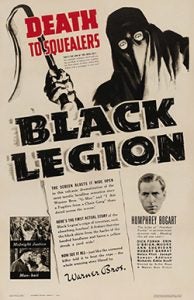
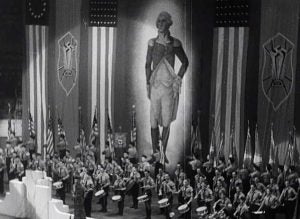
The rise of Adolf Hitler’s Nazi Party to power in Germany in 1933 inspired the creation of a number of radical right-wing movements here in the United States. The most infamous of these groups, was the Friends of New Germany, who in 1936 would rename themselves the German-American Bund and openly pattern themselves on and embrace German Nazism. Other groups included William Dudley Pelley’s Silver Legion of America (the “Silver Shirts”), Father Charles Coughlin’s Christian Front, and the Black Legion. The latter group was involved in several murders in the industrial Midwest, and became so infamous that they were the subject of a 1936 Warner Brothers film starring Humphrey Bogart.
This growth in domestic fascism and right-wing radicalism soon produced what historian Leo Ribuffo has called the “Brown Scare”: an often exaggerated fear of the threat posed by the radical right, in response to the alarming rise of the Third Reich in Europe and the frequently repellent activities of its supporters in the U.S. The Brown Scare soon penetrated the popular culture. In addition to films like Black Legion, Sinclair Lewis’s ironically titled 1935 novel It Can’t Happen Here warned of a fascist takeover of America. Media outlets, such as newspapers, magazines, and radio, likewise struck up the alarm. A number of civil society organizations also led the charge against the emerging radical right. Groups such as the Friends of Democracy, Non-Sectarian Anti-Nazi League, and Mobilization for Democracy, exposed real and alleged fascist activities and mobilized public opinion against the newly-perceived threat.
The Brown Scare soon inspired governmental action against the believed threat of fascist subversion. Both the Roosevelt Administration and its allies in Congress quickly embraced the politics of the Brown Scare. Among other consequences, it would lead a New Deal Democrat, Rep. Samuel Dickstein (D-NY), to play a crucial role in creating what would become the House Un-American Activities Committee (HUAC). President Roosevelt himself was committed to using the power of the federal government to root out domestic fascism, regardless of civil liberties concerns. It was Roosevelt who empowered J. Edgar Hoover and the FBI to engage in domestic political surveillance, starting in 1934.
As the perceived threat posed by foreign and domestic fascism grew, the Brown Scare only intensified. At home, events such as the 1938 discovery of a Nazi spy ring in New York City, and the German-American Bund’s infamous February 1939 rally at Madison Square Garden increased pressure to act against the radical right. Abroad, the continued successes of Nazi Germany and Fascist Italy contributed to the growing concerns. One especially infamous quote uttered in the fall of 1936, during the Spanish Civil War, came to encapsulate this environment. In an offhand comment, Spanish Nationalist General Emilio Mola referred to a nationalist “fifth column” that would capture the city of Madrid from within. The phrase “fifth column” soon went viral, to borrow a contemporary term, spreading rapidly around the world. It was embraced wholeheartedly by supporters of the Brown Scare, for whom it came to embody the fear that the Bund, Silver Shirts, and other domestic fascists could be used by the Third Reich to weaken and subvert the US from within.
FDR openly adopted the idea of the “fifth column” to justify acting against domestic fascist groups. On May 26, 1940, in the midst of Germany’s relatively quick victories in western Europe, Roosevelt warned in a radio address about “the Trojan Horse. The Fifth Column that betrays a nation unprepared for treachery.” He went on to elaborate by stating that this internal enemy would seek “to create confusion of counsel, public indecision, political paralysis and, eventually, a state of panic…. The unity of the State can be sapped so that its strength is destroyed.” (Roosevelt’s Address on the “Fifth Column”)
Powered by such fears, the Brown Scare soon culminated in a campaign of legal persecution at federal, state, and local level. Both the head of the Bund, Fritz Kuhn, and the Silver Shirts, William Dudley Pelley, were arrested and tried. Kuhn was convicted in New York in 1939 for embezzling Bund funds, sent to prison, and eventually deported. Pelley was convicted by the federal government in 1942 on charges of sedition. He then became one of 30 defendants charged in a 1944 case, United States v. McWilliams, that alleged the defendants to be part of a conspiracy to engage in pro-Axis subversion. In a certain irony, many radical right organizations and individuals who embraced a right-wing version of the countersubversive ethos likewise found themselves targets of the Brown Scare. Elizabeth Dilling, author of the infamous 1934 guilt-by-association work The Red Network, joined Pelley among the defendants in United States v. McWilliams. As loathsome as Pelley, Dilling and many of the other defendants were, the charges were extremely questionable, and the great sedition trial of 1944 is generally considered a travesty of justice.
This case would end in a mistrial after the death of the judge, an event that marked the de facto end of the Brown Scare. The defeat of the Axis both discredited fascism and greatly reduced its salience as a domestic threat. In addition, the onset of the Cold War and the rise of the Second Red Scare would soon once again give right-wing countersubversion the upper hand.
As with the Red Scare of 1919-1920, the Brown Scare of 1933-1944 was rooted in a real threat, yet greatly exaggerated both the extent and scale of that threat. In the words of historian Alex Goodall:
The groups and individuals on the radical Right that might be reasonably described as fascist or cryptofascist…. added up to a tiny fraction of the population: no more than a few hundred thousand people in a nation of 130 million…. Right-wing extremists could cause trouble in their localities, but were largely impotent on the national stage. Noxious as they were, they never presented a meaningful threat to American institutions or spoke for more than a tiny minority of American citizens. (Goodall, Loyalty and Liberty, 194)
The major legacy of the Brown Scare was the manner in which it helped prepare the way for future countersubversive measures that gravely threatened civil liberties. The “fifth column” panic was one of a number of factors that led to the internment of Japanese-Americans in 1942. The Brown Scare’s mix of congressional investigation, executive branch law enforcement/surveillance activities, and civic activism provided a template for McCarthyism and the Second Red Scare. As historian John Earl Haynes described it:
Much of the popular image of American communism that appeared after 1945 was based on attitudes developed in the 1930s and early 1940s toward fascism…. And the techniques developed to fight American fascism and American fifth-column activity in the 1930s were the same as those used against American Communists in the late 1940s and 1950s. (Haynes, Red Scare or Red Menace, 19)
Finally, the willingness of some to label any opponent of the New Deal, or of American entry into World War II as fascist or pro-Nazi left many right-wing countersubversives with a keen desire to return the favor. They would eagerly seize on the opportunity to do so during the McCarthy Era.
Primary Sources From the Brown Scare
Carlson, John Roy. Under Cover. New York: E.P. Dutton & Co., Inc., 1943. (Joyner Stacks: E743.5 .D4)
Lewis, Sinclair. It Can’t Happen Here: A Novel. Garden City, N. Y.: Doubleday, Doran & Company, Inc., 1936. (Joyner Stacks: PS3523.E94 I6 1936; currently missing)
Rogge, O. John. The Official German Report: Nazi Penetration, 1924-1942. New York: T. Yoseloff, 1961. (Joyner Stacks: E743.5 .R64)
Beekman, Scott. William Dudley Pelley: A Life in Right-Wing Extremism and the Occult. Syracuse, N.Y.: Syracuse University Press, 2005. (Joyner Stacks: E748 .W23 D48 2013)
Goodall, Alex. Loyalty and Liberty: American Countersubversion from World War I to the McCarthy Era. Urbana: University of Illinois Press, 2013. (Joyner Stacks: E743.5 .G63 2013)
Hart, Bradley W. Hitler’s American Friends : The Third Reich’s Supporters in the United States. New York: St. Martin’s Press, 2018. (On order for Joyner Library)
Haynes, John Earl. Red Scare or Red Menace?: American Communism and Anticommunism in the Cold War Era. Chicago: Ivan R. Dee, 1996. (Joyner Stacks: HX83 .H36 1996)
Ribuffo, Leo P. The Old Christian Right: The Protestant Far Right from the Great Depression to the Cold War . Philadelphia: Temple University Press, 1983. (Joyner Stacks: E806 .R47 1983)
Smith, Geoffrey S. To Save a Nation; American Countersubversives, the New Deal, and the Coming of World War II. New York: Basic Books, 1973. (Joyner Stacks: E806 .S684)
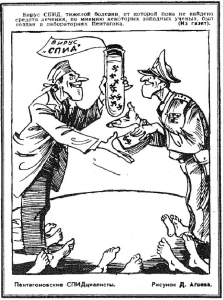
Cartoon published in Pravda, October 31, 1986, alleging that AIDS was the work of American biological warfare researchers. Reproduced in: Geissler, Erhard and Robert Hunt Sprinkle. “Disinformation squared: Was the HIV-from-Fort-Detrick Myth a Stasi Success?” Politics and the Life Sciences: The Journal of the Association for Politics and the Life Sciences 32 2 (2013): 2-99. P.27. DOI:10.2990/32_2_2.
Of all the many disinformation campaigns inaugurated during the Cold War, most but not all by the USSR, arguably the most infamous was the effort by the KGB and its allies to convince the world that AIDS was created in an alleged secret US biowarfare lab at Ft. Detrick, MD. The campaign incorporated the efforts of the KGB’s Service A, responsible for active measures efforts, along with their counterparts in the East German Stasi, and other Warsaw Pact secret services. Dubbed Operation Denver by the East Germans, the campaign began in 1983 and intensified in 1985, before being wound down in late 1987.
Despite being refuted by all credible medical experts, the AIDS as bioweapon theory has lingered on, serving as a sort of gateway drug to other conspiracy theories, and paving the way for later falsehoods regarding diseases such as Ebola virus and COVID-19.
Origins of the Campaign
Claims that various disease outbreaks were the result of American machinations were nothing new for the Communist Bloc. During the Korean War, China and North Korea mounted two extensive propaganda campaigns alleging that the US was employing biological warfare (BW). Even after the United States officially dismantled its BW program in the 1970s, such efforts at “active measures” continued. In 1981, Cuba claimed that an outbreak of Dengue Fever was caused by the CIA. The next year, the KGB-controlled Soviet journal Literaturnaya Gazeta published an “expose” arguing that a University of Maryland-operated bioresearch facility in Lahore, Pakistan was really a BW lab producing disease-bearing mosquitos for deliberate release. Unfounded as they were, the allegations created a furor that forced the lab director to leave the country.
With the horrific emergence of AIDS in the early 1980s, it was inevitable that the KGB would seek to incorporate this epidemic into their pantheon of medical disinformation theories. The first attempt came on July 16, 1983, when a Soviet-funded Indian newspaper named The Patriot published a letter allegedly written by an anonymous American scientist. The letter, in the words of scholar Thomas Rid, “was a masterfully executed disinformation operation: comprising about 20 percent forgery and 80 percent fact, truth and lies woven together, it was an eloquent, well-researched piece.” (Rid, Active Measures, 303)
The “letter” warned that AIDS was created as a result of Pentagon BW experiments centered around the research facility at Ft. Detrick, and tied into the Lahore lab allegations by claiming that this research would soon be transferred to Pakistan. The goal of the piece was to use fear of AIDS to mobilize anti-American sentiment in India. However, the article did not produce the desired reaction, and it would be two years before another attempt would be made to build an active measures campaign involving AIDS.
By the summer of 1985, the KGB had decided to launch a major disinformation campaign in support of the AIDS/Ft. Detrick falsehood. In a September 7, 1985 message to the Bulgarian intelligence service, the KGB stated that:
We are conducting a series of [active] measures in connection with the appearance in recent years in the USA of a new and dangerous disease, “Acquired Immune Deficiency Syndrome – AIDS”…, and its subsequent, large-scale spread to other countries, including those in Western Europe. The goal of these measures is to create a favorable opinion for us abroad that this disease is the result of secret experiments with a new type of biological weapon by the secret services of the USA and the Pentagon that spun out of control. (quoted in Selvage and Nehring, Operation “Denver”)
The effort went public on October 30, 1985, with an article in Literaturnaya Gazeta titled “Panic in the West.” This piece repeated the main themes of the Ft. Detrick allegation, and cited the July 1983 Patriot article in support of its argument. As the campaign evolved, the KGB and its east European allies made much of the thesis that the origins of AIDS lay on the African continent. This aroused a great deal of resentment among many Africans, who felt that the West was blaming them for the rapidly growing pandemic. Exploiting these sentiments by offering an alternative explanation of the origin of AIDS became a major focus of the KGB’s efforts.
At the same time, East German intelligence, known as the Stasi, assumed an increasingly important role in the AIDS active measures push. In July 1986, Department X (ten) of the Stasi’s foreign intelligence branch, responsible for disinformation efforts, officially adopted the code name “Operation Denver” for the AIDS campaign. On September 3, 1986, Department X updated the Bulgarians on their efforts:
With the goal of exposing the dangers to mankind arising from the research, production, and use of biological weapons, and also in order to strengthen anti-American sentiments in the world and to spark domestic political controversies in the USA, the GDR side will present you with a scientific study and other materials that prove that AIDS originated in the USA, not in Africa, and that AIDS is a product of the USA’s bioweapons research. (Quoted in Selvage, ‘Operation “Denver”,’ 103)
A major development came in August 1986, when the Non-Aligned Movement met in Harare, Zimbabwe. Attendees and journalists were flooded with copies of a brochure titled “AIDS: USA Home-Made Evil, NOT out of AFRICA.” Written by a pair of communist scientists living in East Germany, Jakob and Lilli Segal, the brochure argued that AIDS was a product of Ft. Detrick. The pamphlet gained great notoriety, and the Segals were soon embraced by those supporting the Ft. Detrick conspiracy theory.
Another key moment for Operation Denver came on October 29, 1986, when a British tabloid, the Sunday Express, became the first major western news outlet to run a story based on Jakob Segal’s claims. The Detrick conspiracy theory continued to spread in the first part of 1987. According to Thomas Rid, over 40 articles worldwide concerning the allegations appeared between January-March 1987. (Rid, Active Measures, 309) Perhaps the peak moment of Operation Denver came on March 30, 1987, when an Associated Press item summarizing Soviet allegations about AIDS and Ft. Detrick was briefly reported without criticism or comment on the CBS Evening News.
At the same time as Operation Denver reached its peak, the US government was aggressively pushing back against the campaign. A special interagency Active Measures Working Group, formed in 1981, now placed a special focus on rebutting the AIDS allegations. After Secretary of State George Shultz directly challenged Mikhail Gorbachev about AIDS disinformation in a meeting on October 23, 1987, the Soviets began to back away from the effort. On October 30, Izvestiya, a major Soviet newspaper, published an article by two Soviet scientists denying that AIDS was man-made.
This article marked the de facto end of Operation Denver. The enormous publicity generated by the campaign had produced an American public response that made the effort no longer worth it. At the same time, the spread of AIDS within the USSR made it imperative that Soviet doctors have accurate information about the pandemic. The KGB and Stasi did not abandon the campaign entirely, however. They also launched new active measures efforts, such as allegations that Latin American children were being abducted and having their organs harvested for the benefit of wealthy Americans in need of a transplant.
Jakob Segal, who was enabled by the Stasi, but seems to have genuinely believed the allegations and acted on his own initiative, insisted until his death in 1995 that AIDS was created in an American lab.
Denver’s Impact and Legacy
The impact of Operation Denver lingered long after the demise of both the KGB and Stasi in 1990-1. The allegations resonated with many in the Third World, as well as some Gay Americans and racial minorities in the US. Many of those who had a history of being ill-treated by the US government, and thus had a justified suspicion of it, were inclined to accept the KGB/Stasi claims, no matter how far fetched. This is the key to any successful disinformation campaign: it can only work if there is an audience predisposed to believe it.
Among other effects, the AIDS as bioweapon claim remained on the fringes of those communities where it had gained a foothold, serving as a gateway to further conspiracy theories. It has been embraced by Kanye West, among others. Finally, Operation Denver has helped pave the way for the all too numerous medical disinformation efforts that have come since. Conspiracy theories regarding the origins of Ebola and COVID-19, nonsensical claims of American biowarfare labs around the world, and baseless theories attacking the safety of COVID vaccines, all are in part legacies of the KGB’s active measures “success” involving AIDS.
Geissler, Erhard and Robert Hunt Sprinkle. “Disinformation Squared: Was the HIV-from-Fort-Detrick Myth a Stasi Success?” Politics and the Life Sciences: The Journal of the Association for Politics and the Life Sciences 2013; 32 (2): 2-99. DOI:10.2990/32_2_2.
Rid, Thomas. Active Measures: The Secret History of Disinformation and Political Warfare. New York: Farrar, Straus and Giroux, 2020.
Schoen, Fletcher and Christopher J. Lamb. Deception, Disinformation, and Strategic Communications: How One Interagency Group Made a Major Difference. Washington, D.C.: National Defense University Press, 2012. purl.fdlp.gov/GPO/gpo60199.
Selvage, Douglas. Operation “Denver”: The East German Ministry of State Security and the KGB’s AIDS Disinformation Campaign, 1985–1986 (Part 1). Journal of Cold War Studies 2019; 21 (4): 71–123. DOI: 10.1162/jcws_a_00907.
Selvage, Douglas. “Operation “Denver”: The East German Ministry for State Security and the KGB’s AIDS Disinformation Campaign, 1986–1989 (Part 2).” Journal of Cold War Studies 2021; 23 (3): 4-80. DOI: 10.1162/jcws_a_01024.
On November 16, I was honored to deliver the presentation “A Favorite Pastime: Disease and Disinformation in the Cold War” as part of Laupus Library’s Medical History Interest Group series. A copy of the slides and a related bibliography are attached below:
On June 10th, I was privileged to deliver a presentation on the Russian invasion of Ukraine to the North Carolina Library Association’s Government Resources Section Summer Workshop. A link to a PDF copy of my slides is below, as well as links to previous CWIS blog posts offering resources on the war and its historical background.
For Part One (general federal documents sources), click here.
The following is a select list of sources on the Russian armed forces and the military situation in eastern Europe since 2014. The focus is on material produced by the US federal government, though useful non-government and international resources are also provided.
1. Congressional Publications on the Russian Military (2014-present)
McCarthy, Michael C., Matthew A. Moyer and Brett H. Venable. Deterring Russia in the Gray Zone. Carlisle Barracks, PA: Strategic Studies Institute and U.S. Army War College Press, 2019.
The following is a select list of documents, websites, books and other resources that provide information, background and perspective on the current conflict between Russia and Ukraine. The list below is meant simply as a starting point for research. While the emphasis is on publications and sources produced by the US government, other types of resources are also included. This conflict began in 2014 with the Russian occupation of the Crimean peninsula, the proxy occupation of parts of eastern Ukraine, and now has escalated into an open Russian military invasion.
Giles, Keir. Moscow Rules: What Drives Russia to Confront the West. Washington, D.C.: Brookings Institution Press; London: Chatham House, The Royal Institute of International Affairs, 2019. (On order for Joyner Library)
Investigation of the Ukrainian Famine, 1932-1933: Report to Congress. Commission on the Ukraine Famine, 1988. (Joyner Docs Stacks Y 3. Uk 7: F 21/988)
Martin, Terry. The Affirmative Action Empire: Nations and Nationalism in the Soviet Union, 1923-1939. Ithaca, New York:Cornell University Press, 2010. (Joyner Stacks JN6520.M5 M27 2001)
Oral History Project of the Commission on the Ukraine Famine. Commission on the Ukraine Famine, 1990, 3 v. (Joyner Docs Stacks Y 3. Uk 7: F 21/990/v.1-3)
Plokhy, Serhii. The Gates of Europe: A History of Ukraine. Rev. ed. New York: Basic Books, 2021. (Joyner New Books DK508.51 .P554 2021)
Plokhy, Serhii. Lost Kingdom: The Quest for Empire and the Making of the Russian Nation, From 1470 to the Present. New York: Basic Books, 2017. (Joyner Stacks DK43 .P56 2017)
Snyder, Timothy. Bloodlands: Europe Between Hitler and Stalin. New York: Basic Books, 2010. (Joyner Stacks DJK49 .S69 2010)
One consequence of the COVID-19 pandemic has been the numerous charges and counter-charges regarding the origins of the virus. In particular, the allegations by the Trump administration that the pandemic was the result of research done at a scientific laboratory in Wuhan, China that then leaked out. Both China and Russia have countered with claims that the COVID pandemic was actually created, purposefully or not, by the United States.
Such competing political claims regarding the origins of diseases are nothing new. They were, in fact, a regular staple of the Cold War information and propaganda contest. The USSR and its allies from the early 1950s regularly blamed domestic diseases and crop failures on American efforts at biological warfare (BW). Most famously, the 1980s KGB active measures campaign “Operation Denver” claimed that the AIDS virus was created at a U.S. Army biological research facility at Fort Detrick, MD. In turn the U.S. alleged that a 1979 anthrax outbreak in the Soviet city of Sverdlovsk was the result of a biological warfare accident (true), and that in the early 1980s the USSR used a mycotoxin dubbed “yellow rain” in Afghanistan and Southeast Asia (unproven: likely false.)
The earliest major Cold War controversy involving allegations of BW was a series of claims by China and North Korea in 1951-52 that the United States employed biological weapons during the Korean War. While vehemently denied by the US, these charges were treated as credible by much of the left in Western Europe, and by a large part of what would soon become known as the Third World. Most western scholars have rejected the allegations, noting that credible evidence of US BW use is lacking. Post-Cold War Soviet and Chinese revelations, in particular, have cast tremendous doubt on the communist charges.
Unit 731 and the Origins of the Campaign
It is difficult to understand the Korean War BW controversy without putting it in the context of Japan’s WWII biological weapons program. Imperial Japan had an extensive BW program between 1932-45, with its largest, most infamous element, Unit 731, located in Manchuria, directly north of the Korean peninsula. According to scholar Sheldon H. Harris, Japan’s horrific BW activities, both gruesome experiments and actual use of bacteriological weapons, killed some 250,000 people in China and Manchuria. After the war, many of the leading figures in Japan’s BW program were captured by American occupation authorities. This included the longtime head of Unit 731, General Shiro Ishii. Shamefully, the American authorities granted Ishii and his colleagues immunity from prosecution, in return for providing US intelligence with the results of their research.
In contrast, the USSR, in December 1949 staged a trial at Khabarovsk in the Soviet Far East, in which 12 captured Japanese officers tied to Unit 731 were tried for war crimes. On the one hand, the trial did much to expose the terrible truth of Japan’s BW program. However, it was also a propaganda event designed to embarrass the United States and Japan. In addition to noting that Ishii and his colleagues were protected by the U.S., the Soviets claimed that Ishii was continuing his BW efforts at American behest, and even demanded the extradition of Emperor Hirohito for complicity in Unit 731’s activities.
The crimes of Unit 731 played a key part in the communist allegations of American BW use in Korea. Many of the reported biological attacks directly matched Japanese methods used during WW II. In addition, Unit 731 was prominently featured in communist propaganda even before the first allegations of American bacteriological warfare were made. In the words of scholar Milton Leitenberg:
In the first five months of 1951, the Chinese press and radio made repeated references to Gen. Ishii and the Japanese wartime BW programs, the Khabarovsk trial, Gen. Ishii’s subsequent employment by the United States, and the claim that the United States was preparing to use BW in the Korean War.
(Leitenberg, “New Russian Evidence,” 188)
Two Waves of Charges
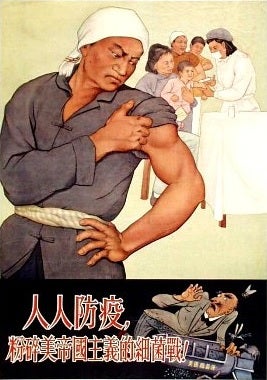
“Chinese propaganda poster from the Korean War era: “Vaccinate everyone, to crush the germ warfare of American imperialism!”” Image via Wikipedia Found via Wilson Center Digital Archive
The Korean War began on June 25, 1950, when communist North Korea invaded pro-western South Korea. As noted above, after communist China entered the war in late 1950 to save North Korea from defeat, Chinese media outlets offered frequent warnings that the US was preparing to resort to BW. It was not until May 8, 1951, that the first allegation of actual BW use was made, when North Korea’s foreign minister accused the US of having spread smallpox in parts of North Korea. Occasional Chinese and North Korean claims of American biological weapons use continued into the summer of 1951. In addition to BW, the Chinese also claimed during this period that US forces employed poison gas.
The main communist campaign claiming that America was using BW came in the winter and spring of 1952. On February 22, 1952, the North Korean Foreign Minister once again accused the United States of using biological weapons. This time, the allegations were that American planes dropped a variety of insects over North Korea, carrying diseases such as plague, anthrax, and cholera. The methods described were virtually identical to those used by the Japanese in China during WWII. The charges were soon echoed by the Chinese, who claimed that US aircraft were engaged in such activities over both North Korea and northeast China, with American planes allegedly flying about 1,000 BW-related sorties over the latter region between January-March 1952. As evidence, the Chinese produced insects they claimed were dropped from US aircraft, American leaflet bombs that they claimed had been used to deliver these insects, and coerced interrogations from several dozen captured American airmen.
By-mid March, the two communist countries, joined by their patron the Soviet Union, had embarked on a massive propaganda campaign based on the BW charges. The Soviets, through their front organization the World Peace Council, stirred up anti-American sentiment in western Europe and elsewhere. China, while spurning offers of an investigation by the International Red Cross or World Health Organization, assembled two investigative committees composed of sympathetic individuals that released reports supporting the communist allegations. Within China, the Maoist regime used the hysteria whipped up by the BW charges to launch a “patriotic hygiene” campaign that mobilized much of the Chinese population in support of a sweeping vaccination and public health effort.
Starting in early March, the United States vehemently denied the communist allegations. The biological warfare controversy began to fade by the fall of 1952, and soon became a historical footnote with the Korean War armistice of May 1953.
Recent Revelations
“Chinese photograph of infected fleas allegedly spread by the United States” Image via Wikimedia Commons.
Since the Korean War, the question of whether the United States engaged in biological warfare has occasionally fostered controversy. China and North Korea insist to this day that the BW allegations were true. Most western historians disagree. A small group of radical left western scholars have periodically tried to validate the communist charges and prove the US guilty of employing BW in Korea. The most recent effort in this regard is writer Nicholson Baker’s 2020 book Baseless. The book summarizes the case for American guilt, but is ultimately shoddy and unconvincing.
The bulk of the evidence strongly indicates that the communist charges are false if not outright fabricated. For one thing, there is no direct documentary evidence that America tried to employ BW in Korea, While the US did have a biological warfare program at the time, scholars such as Conrad Crane have shown that America lacked the ability to wage a campaign such as the Chinese and North Koreans alleged. Also, there were no actual widespread epidemics reported in China, and none in North Korea that couldn’t be explained by natural methods of disease spread. The only evidence produced in support of the charges was by the communists themselves. The “confessions” by American POWs were repudiated as soon as those men returned to the United States.
The most conclusive evidence refuting the communist allegations emerged in the 1990s from China and the former Soviet Union. In 1997, Wu Zhili, the head of medical services for Chinese forces during the Korean War, wrote a brief memoir reflecting on his 1952 investigation of alleged US BW use. Discovered after his death in 2008, the document was published in a Chinese publication in 2013:
(1) Imperialism is capable of carrying out all manner of evils, and bacteriological war is not an exception. (2) Severe winter, however, is not a good season for conducting bacteriological war. When the weather is cold the mobility of insects is weakened, and is not conducive to bacteria reproduction. (3) Dropping [objects] on the front line trenches, where there are few people and sickness does not spread easily, and where the U.S. military’s trenches are not more than ten meters away, allows for the possibility of ricocheting. (4) Korea already had an epidemic of lice-borne contagious diseases. All the houses in the cities and towns had been burned down, and the common people all lived in air-raid shelters. Their lives are already difficult, but the Korean people are extremely tenacious and bacteriological warfare cannot be the greater disaster that forces them to surrender. (5) Our preliminary investigation still could not prove that the U.S. military carried out bacteriological warfare.
(“Wu Zhili, ‘The Bacteriological War of 1952 is a False Alarm'”)
In conclusion, Wu wrote, “the bacteriological war of 1952 was a false alarm.”
Even more damning, in 1998 a Japanese newspaper obtained copies of a number of high-level Soviet documents from April and May 1953 concerning the Korean War BW allegations. The documents show that the senior leadership of the Soviet Communist Party, who had just taken power after the March 1953 death of Joseph Stalin, quickly and unabashedly labeled the allegations as fabricated. Perhaps the most important document is a May 2, 1953 message from the new Soviet leadership directly to Mao Tse-Tung:
The Soviet Government and the Central Committee of the CPSU were misled. The spread in the press of information about the use by the Americans of bacteriological weapons in Korea was based on false information. The accusations against the Americans were fictitious.
(Resolution of the Presidium of the USSR Council of Ministers)
While it appears that the Chinese and North Koreans may have genuinely believed in early 1952 that the United States was using BW against them, they soon realized that this was not the case. Nonetheless, they cynically continued making the charges, for purposes of international propaganda and domestic mobilization. This would be only one of many such situations during the Cold War in which real and fictitious incidents of disease and BW activity would become tools of global political warfare.
Sources:
Baker, Nicholson. Baseless: My Search for Truth in the Ruins of the Freedom of Information Act. New York: Penguin Press, 2020.
Crane, Conrad C. “‘No Practical Capabilities’: American Biological and Chemical Warfare Programs During the Korean War,” Perspectives in Biology and Medicine 45, no. 2 (Spring 2002): 241-249. DOI: 0.1353/pbm.2002.0024.
Harris, Sheldon H. Factories of Death: Japanese Biological Warfare, 1932-1945, and the American Cover-Up. New York: Routledge, 2002. (Joyner Stacks: DS777.533.B55 H37 2002)
Jager, Sheila Miyoshi. Brothers at War: The Unending Conflict in Korea. New York: W. W. Norton & Company, 2013. (On order for Joyner Library)
Materials on the Trial of Former Servicemen of the Japanese Army Charged with Manufacturing and Employing Bacteriological Weapons. Moscow: Foreign Languages Publishing House, 1950. (Joyner Stacks: KLA44.Y36 Y3613 1950)
Regis, Ed. The Biology of Doom: The History of America’s Secret Germ Warfare Project. New York: Henry Holt, 1999. (Joyner Stacks: UG447.8 .R44 1999)
“Resolution of the Presidium of the USSR Council of Ministers about Letters to the Ambassador of the USSR in the PRC, V.V. Kuznetsov and to the Charge d’Affaires for the USSR in the DPRK, S.P. Suzdalev,” May 02, 1953, History and Public Policy Program Digital Archive, Archive of the President of the Russian Federation. Translated by Kathryn Weathersby. https://digitalarchive.wilsoncenter.org/document/112030
Wilson Center Digital Archive: ‘Korean War Biological Warfare Allegations.” -“A collection of primary source documents related to the Korean War. Obtained largely from Russian archives, the documents include reports on Chinese and Soviet aid to North Korea, allegations that America used biological weapons, and the armistice.”
“Wu Zhili, ‘The Bacteriological War of 1952 is a False Alarm’,” September 1997, History and Public Policy Program Digital Archive, Yanhuang chunqiu no. 11 (2013): 36-39. Translated by Drew Casey. https://digitalarchive.wilsoncenter.org/document/123080
By 1956, the Communist Party of the United States of America (CPUSA) had ceased to be relevant. Having barely survived the intensive internal security measures implemented by the U.S. government in the early 1950s, the main blow to the CPUSA came, ironically enough, from the party’s Soviet patron. Nikita Khrushchev’s February 1956 “secret speech,” which implicated his predecessor Joseph Stalin in numerous crimes, brutally disabused many party members of their notion that Stalin’s Soviet Union represented a bright pinnacle of human progress. Most CPUSA members left the party by the end of the decade.
The demise of the CPUSA did not, however, stop the House Un-American Activities Committee (HUAC) from continuing its relentless campaign to root out any vestige of communist influence from American society, however trivial. By the mid-1950s, the committee’s public hearings into the remnants of the CPUSA had evolved into a performative shaming ritual in which those witnesses who took the Fifth Amendment to avoid self-incrimination were then subject to a variety of social sanctions, frequently including denial of employment.
In the summer of 1956, HUAC would travel to Philadelphia to hold a hearing into a Quaker-run local library that employed a librarian who once had CPUSA ties. On this occasion, however, the library and librarian in question defied HUAC and the culture of performative shaming it represented.
Mary Knowles and the William Jeanes Memorial Library
In August 1953, the William Jeanes Memorial Library, in Plymouth Meeting, PA, found itself in need of a replacement librarian after the current librarian broke her leg. The library, run by the local Quaker community, hired Mary Knowles, a librarian who had recently moved to the area from Boston. After the previous librarian decided to retire, Knowles was hired as the new permanent librarian in September 1954.
Knowles was praised for her excellent work at Jeanes Memorial, but she had one drawback: she was very much a target of the congressional countersubversive apparatus represented by HUAC and several other committees. Mary’s former husband, Clyde Knowles, was a CPUSA activist, and from 1945-47, she worked as secretary at the CPUSA-affiliated Samuel Adams School in Boston. In May 1953, a former Boston-area CPUSA member named Herbert Philbrick identified Mary Knowles as “a member of the Communist Party, and in fact a member of my own pro-group underground cell” in testimony before the Senate Internal Security Subcommittee (SISS). (Subversive Influence, Part 9, 944)
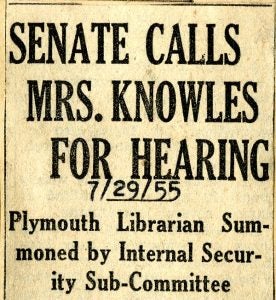
Philbrick’s certainty in identifying Knowles as a communist before SISS stood in stark contrast to his closed-door testimony before HUAC in 1951. At this earlier appearance, Philbrick had answered “Not that I recall at this time” when asked if Mary Knowles was a CPUSA member. (Expose of Communist Activities, 131) Nevertheless, Philbrick’s improved memory resulted in Knowles being fired from her job at the South Norwood (MA) Branch Library, and herself being called to testify before SISS on May 21, 1953, where she invoked the Fifth Amendment. Ironically, it was SISS’s pursuit of Knowles that made her available to take the Plymouth Meeting job.
Knowles was upfront with the Plymouth Meeting Library Committee about her issues. The committee and its chair, Lillian Tapley, decided to employ her regardless. Upon Knowles’s permanent employment in September 1954, controversy ensued. The local township withdrew its financial support from the library, and the school board instructed students not to use Jeanes Library. By early 1955, the clamor had grown more intense, as groups such as the American Legion and Daughters of the American Revolution called for Knowles to be fired. The library committee, however, despite several resignations, remained firmly on Knowles’s side.
In the midst of this controversy, there were two events that further exacerbated the situation. First, in May 1955, a civil liberties nonprofit called the Fund for the Republic granted Plymouth Meeting a $5,000 award “in recognition of its forthright stand in defense of individual freedom” by employing Mary Knowles. The Fund’s president, former University of Chicago head Robert Maynard Hutchins, expressed the hope “that Plymouth Monthly Meeting’s example will be followed elsewhere in America, particularly when our libraries—which seem to be a special target of self-appointed censors and amateur loyalty experts—are involved.” (Quoted in Mayer, Robert Maynard Hutchins, 432)
The Fund’s award only served to enrage the countersubversives, in Congress and elsewhere, who wanted Knowles fired. This led to the second event, which was that Mary Knowles was again subpoenaed to testify before SISS. Testifying on September 15, 1955, she once again declined to cooperate with the committee. This time, however, she did so without invoking the Fifth Amendment, but rather by making the following argument:
First, that I am not a Communist; that I am not a member of the Communist Party, and that for many, many years I have had no connection, direct or indirect, with any organization on the Attorney General’s list.
Further than that I have no knowledge of any matters concerning national security; I have no knowledge of any matters concerning the Internal Security Act of 1950; I have no knowledge of any matters of subversion, sabotage, or espionage, of infiltration, of violent overthrow of the Government, of any acts concerning any foreign powers or any other illegal act.
In view of these things and the fact that I am a private citizen employed in a private institution under the care of a religious organization, I feel that I have no information that would be within the power or the jurisdiction of this duly organized committee to ask of me. (Subversive Influence, Part 14, 549)
As a result of her refusal to cooperate with SISS, the Senate voted on April 17, 1956 to hold Mary Knowles in contempt of Congress.
HUAC Enters the Picture
Representative Francis Walter (D-PA), Chair of HUAC from 1955-63. Walter was instrumental in inserting HUAC into the Plymouth Meeting controversy. Image via Biographical Directory of the United States Congress. Source: https://bioguide.congress.gov/search/bio/W000108
In addition to supporting Plymouth Meeting for retaining Mary Knowles, the Fund for the Republic with much fanfare also produced a report critical of blacklisting in the entertainment industry, which was published in late June 1956. This drew the ire of the House Un-American Activities Committee and its chair, Rep. Francis Walter (D-PA). In May 1956, HUAC quietly began an investigation of the Fund, publicly announcing its investigation in June.
After holding six days of hearings in early July criticizing the Fund’s report on blacklisting, Walter took advantage of a subcommittee visit to Philadelphia in mid-July to hold a one-day hearing on the Plymouth Meeting controversy. Held on July 18, 1956, the hearing was officially about the Fund’s award to Plymouth Meeting. It soon became clear, however, that the hearing was little more than an attempt to shame and embarrass both Plymouth Meeting and the Fund for the Republic. Of the six witnesses called, four were local residents critical of Mary Knowles’s employment. A fifth was Maureen Black Ogden, an investigator for the Fund who recommended the Plymouth Meeting award. She was of course harshly grilled by Walter’s subcommittee. Only Lillian Tapley was allowed to make the case on behalf of the Plymouth Meeting Library Committee.
The outrageous nature of the hearing was aptly summarized in a July 24 letter written by nine Philadelphia area Quakers, and addressed to the HUAC members not present at the hearing:
It is our opinion that what took place was a travesty upon the word “investigation” and a mockery of the idea of inquiry. It appears rather to have been an organized attempt to present selected facts in the light most discreditable to the Fund for the Republic, Inc. We refer in part to the number and order in which witnesses were called; the close questioning of witnesses of one point of view, and the obvious sympathy with those of another; the repeated rejection of proffers of fact by individual witnesses; the deliberate cultivation of hearsay testimony which fitted their thesis; and like irregularities. (Quoted in The Plymouth Meeting Controversy, 30)
Postscript
In January 1957, Mary Knowles was convicted of contempt of Congress for her September 1955 testimony before SISS. Her conviction would be overturned by the Supreme Court in 1961. The Plymouth Meeting Library Committee remained steadfast in its support of Mary Knowles until the controversy subsided, and Jeanes Library thrived under her leadership. Knowles remained at William Jeanes Memorial Library until her retirement in 1979.
Perhaps the final word on the Plymouth Meeting controversy belongs to Hutchins biographer Milton Mayer, in describing Mary Knowles:
Mrs. Mary Knowles did not appear to be redoubtable, but she was; more redoubtable, in the end, than the United States Congress, the Federal Bureau of Investigation, the American Legion, and the most redoubtable representatives of the American press. (Mayer, Robert Maynard Hutchins, 430)
CWIS Sources Featuring Testimony by Mary Knowles:
Subversive Influence in the Educational Process, Part 10: Hearings Before the Subcommittee to Investigate the Administration of the Internal Security Act and Other Internal Security Laws of the Committee on the Judiciary, United States Senate, Eighty-Third Congress, First Session. 1953. (Joyner Docs CWIS: Y 4.J 89/2:SU 1/10/PT. 10)
Subversive Influence in the Educational Process, Part 14: Hearing Before the Subcommittee to Investigate the Administration of the Internal Security Act and Other Internal Security Laws of the Committee on the Judiciary, United States Senate, Eighty-Fourth Congress, First Session. 1955. (Joyner Docs CWIS: Y 4.J 89/2:SU 1/10/PT. 14)
CWIS Sources Featuring Testimony Referring to Mary Knowles:
Investigation of the Award by the Fund for the Republic, Inc., Plymouth Meeting, PA. Hearing before the Committee on Un-American Activities, House of Representatives, Eighty-Fourth Congress, Second Session. 1956. (Joyner Docs CWIS: Y 4.Un 1/2:F 96/2)
Investigation of Un-American Propaganda Activities in the U.S. Appendix, Part 9: Communist Front Organizations: First Section. Special Committee on Un-American Activities, House of Representatives, Seventy-Eighth Congress, Second Session. 1944. (Joyner Docs CWIS: Y 4.UN 1/2:UN 1/944/APP./ V. 1)
-Knowles is mentioned on p. 479
Subversive Influence in the Educational Process, Part 9: Hearings Before the Subcommittee to Investigate the Administration of the Internal Security Act and Other Internal Security Laws of the Committee on the Judiciary, United States Senate, Eighty-Third Congress, First Session. 1953. (Joyner Docs CWIS: Y 4.J 89/2:SU 1/10/PT. 9)
-Herbert Philbrick’s May 1953 testimony. Mary Knowles is referenced on pgs. 890 and 944
Testimony of Walter S. Steele Regarding Communist Activities in the United States. Hearings before the Committee on Un-American Activities, House of Representatives, Eightieth Congress, First Session. 1947. (Joyner Docs CWIS: Y 4.UN 1/2:ST 3)
-Knowles is mentioned on p. 52
U.S. House. Committee on Un-American Activities. Expose of Communist Activities in the State of Massachusetts. (HRG-1951-UAH-0036; Date:
Jun. 18-21, 1951). Text in: ProQuest® Unpublished Hearings Digital Collection; Accessed: September 27, 2021. (ProQuest Congressional: ECU users only)
-Knowles is referenced on p. 131
Other Sources:
Goodman, Walter. The Committee: The Extraordinary Career of the House Committee on Un-American Activities. New York: Farrar, Straus, and Giroux, 1968. (Joyner Stacks: E743.5 .G64)
Hepler, Allison. McCarthyism in the Suburbs: Quakers, Communists, and the Children’s Librarian. Lanham, MD: Lexington Books, 2018. (Joyner Stacks: E743.5 .H45 2018)
Jenkins, Philip. The Cold War at Home: The Red Scare in Pennsylvania, 1945-1960. Chapel Hill: University of North Carolina Press, 1999. (Joyner Stacks: F154 .J46 1999)
Reeves, Thomas C. Freedom and the Foundation: The Fund for the Republic in the Era of McCarthyism. New York: Knopf, 1969. (Joyner Stacks: AS911.F813 R4)
In the late summer and fall of 2020, the U. S. government issued a number of warnings about attempts by foreign governments to influence the upcoming American presidential election, with officials indicating that Russia, China, and Iran posed the main threats. In the last few weeks, the U.S. Intelligence Community (IC) has provided further information on the nature and extent of foreign election influence operations in 2020, information that has permitted us to revise and update the picture presented last fall.
Election Influence Versus Election Interference:
In its analyses, the U.S. IC distinguishes between election influence and election interference. From a March 10 assessment:
Election influence includes overt and covert efforts by foreign governments or actors acting as agents of, or on behalf of, foreign governments intended to affect directly or indirectly a US election – including candidates, political parties, voters or their preferences, or political processes. Election interference is a subset of election influence activities targeted at the technical aspects of the election, including voter registration, casting and counting ballots, or reporting results (Intelligence Community Assessment, 1; bold in original)
In short, election influence involves efforts to impact the opinions and preferences of voters, parties, and candidates. Election interference involves trying to alter the processes and infrastructure of an election, including vote tallies.
After analyzing the evidence the US IC found no evidence of foreign election interference in 2020. In the words of a March 16 joint statement from the Departments of Justice and Homeland Security, while “Russian, Chinese, and Iranian government-affiliated actors materially impacted the security of certain networks during the 2020 federal elections, the Departments found no evidence that any foreign government-affiliated actor manipulated election results or otherwise compromised the integrity of the 2020 federal elections.” (Joint Statement from the Departments)
Foreign government efforts at election influence, however, were another matter.
Election Influence Efforts by Iran and China:
On March 16, the U.S. Intelligence Community released its overall assessment of foreign efforts to influence the course of the 2020 U.S. elections. Among other conclusions, this document confirmed that Iran was involved in such a campaign:
We assess with high confidence that Iran carried out an influence campaign during the 2020 US election season intended to undercut the reelection prospects of former President Trump and to further its longstanding objectives of exacerbating divisions in the US, creating confusion, and undermining the legitimacy of US elections and institutions. (Intelligence Community Assessment, 5)
As far as China, the IC, in contrast to its fall assessments, stated that “China did not deploy interference efforts and considered but did not deploy influence efforts intended to change the outcome of the US presidential election.” This decision by China not to actively seek to influence the election was likely due in part to a Chinese belief that “its traditional influence tools, primarily targeted economic measures and lobbying key individuals and interest groups, would be sufficient to achieve its goal of shaping US policy regardless of who won the election”, as well as the fear that the “risk of interference was not worth the reward.” (Intelligence Community Assessment, 7)
The IC report does note that the National Intelligence Officer for Cyber disagreed with this view, assessing with moderate confidence that the Chinese made some modest efforts to influence the election campaign to Trump’s detriment.
Russian Election Influence Efforts:
One thing the IC assessment makes abundantly clear is that, just as in 2016, Russia was the major foreign state source of efforts to influence the US election process.
We assess that President Putin and the Russian state authorized and conducted influence operations against the 2020 US presidential election aimed at denigrating President Biden and the Democratic Party, supporting former President Trump, undermining public confidence in the electoral process,and exacerbating sociopolitical divisions in the US. (Intelligence Community Assessment, 2)
Confirming previously released information, the March 16 assessment noted that the Russians utilized influence assets in Ukraine to “launder influence narratives–including misleading or unsubstantiated allegations against President Biden—through US media organizations, US officials, and prominent US individuals, some of whom were close to former President Trump and his administration.” (Intelligence Community Assessment, 2)
Among the most notable of these conduits was a Ukrainian legislator named Andriy Derkach, who “has ties to Russian officials as well as Russia’s intelligence services,” and whose activities “Putin had purview over.” Derkach was already sanctioned by the U.S. Treasury Department last September for his election interference activities, including his infamous meeting with President Trump’s personal attorney, Rudolph Giuliani. (Ibid.)
Just as in 2016, the Russian authorities utilized bots, trolls, and other forms of social media activity to spread their preferred U.S. election narratives. Involved in many of these activities was Lakhta Internet Research, the new name for the notorious troll farm formerly known as the Internet Research Agency. According to the March 16 assessment, Russian social media actors also continued their broader attempts to disrupt the cohesion of American society, by promoting “conspiratorial narratives about the COVID-19 pandemic, made allegations of social media censorship, and highlighted US divisions surrounding protests about racial justice.” (Ibid., 4)
New Election Influence Sanctions:
In response to the extent of Russian efforts to influence the outcome of the 2020 U.S. presidential election, on April 15, the Treasury Department announced sanctions “against 16 entities and 16 individuals who attempted to influence the 2020 U.S. presidential election at the direction of the leadership of the Russian Government.” (Treasury Escalates Sanctions)
Among the most notable targets of these new sanctions was an individual named Konstantin Kilimnik. The sanctions announcement identified Kilimnik as:
A Russian and Ukrainian political consultant and known Russian Intelligence Services agent implementing influence operations on their behalf. During the 2016 U.S. presidential election campaign, Kilimnik provided the Russian Intelligence Services with sensitive information on polling and campaign strategy. Additionally, Kilimnik sought to promote the narrative that Ukraine, not Russia, had interfered in the 2016 U.S. presidential election. In 2018, Kilimnik was indicted on charges of obstruction of justice and conspiracy to obstruct justice regarding unregistered lobbying work. (Treasury Escalates Sanctions)
Kilimnik was prominently featured in the Mueller Report due to his close connections with Trump’s former campaign manager Paul Manafort. It was the latter who, in 2016, gave Kilimnik the “sensitive information on polling and campaign strategy” that he then gave to Russian intelligence. While the Mueller Report noted that Manafort gave this data to Kilimnik, the April 15 announcement was the first official confirmation that Kilimnik then passed this information on to the Russians. According to media reports, Kilimnik’s Russian intelligence ties are primarily with military intelligence, the GRU. (see Bertrand, “The Shadowy Operative”) This is the same agency responsible for hacking numerous Democratic Party-related accounts in the spring of 2016, and then releasing the contents to Wikileaks.
The March 16 assessment described Kilimnik as a “Russian influence agent,” part of “A network of Ukraine–linked individuals” who in 2020 “took steps throughout the election cycle to damage US ties to Ukraine, denigrate President Biden and his candidacy, and benefit former President Trump’s prospects for reelection.” (Intelligence Community Assessment, 3)
Among other things, the role of Kilimnik shows the essential underlying continuity of Russian efforts at election influence in both 2016 and 2020. In both elections, the goal was to further divide American society, as well as to weaken the Democratic nominee and boost the prospects of Donald Trump.
Previous CWIS Blog Posts on 2020 Foreign Election Influence/Interference: